Rick Warren’s Recurring Non Sequitur

Steven Waldman has another defense of Pastor Rick Warren up at Beliefnet. He does the best he can, but this paragraph struck me as discordant

Having not learned my lesson, I want to close with another defense of Rick Warren. Despite his lack of self awareness on gay marriage (and the pain he's caused gays), I still think that he deserves to great credit for his extraordinary work in fighting poverty and disease in Africa. This man is saving thousands of lives and we should keep looking at the full Rick Warren.

But how much longer will we continue to allow people to get away with this kind of non sequitur? Rick Warren's dedication to fighting poverty and disease in Africa is not related to, nor a defense of his public pronouncements (and those significant silences) on gay equality.

Vermont

Everybody's probably got the news that Vermont became the first state to adopt same-sex marriage through the legislative process. For those keeping track, California's legislature passed it twice, but our Governor vetoed the bills. Interestingly, so did Vermont's governor, but their legislature overrode the veto. Way to go!

This is remarkable for all the obvious reasons: it was passed by the people's repesentatives, by a wide margin, and without being under court compulsion. I am simply amazed.

But I'm also a bit peeved. I'd hoped California would be the first to do this. Now, the only landmark left for us is to be the first state to have the voters, themselves, adopt same-sex marriage directly. This is going to be a challenge, but we Calfornians are up to it!

Two Awards for Gavin Newsom

The National Gay & Lesbian Task Force bestowed a Leadership Award to San Francisco's Mayor Gavin Newsom on April 6, calling him "a galvanizing force for marriage equality."

Meanwhile, the creator of a highly effective anti-gay marriage ad on behalf of California's Prop. 8, using a news clip featuring Gavin Newsom, won a very different award, from the American Association of Political Consultants. As the San Francisco Chronicle reports:

[Frank Schubert] was happy to give the political pros from across the country a 45-minute seminar on his victorious campaign, where he was asked: "How did you come from 14 points behind in the polls and win?"

Well, Schubert explained, they were very disciplined, they had tremendous support from the faith community and they had "a gift from God: Gavin Newsom."

Whereupon Schubert showed the same-sex-marrying San Francisco mayor delivering his infamous "it's gonna happen, whether you like it or not" line that became the anchor for Schubert's TV campaign.

The place exploded in laughter.

Like many on the left, Newsom gets credit for standing up for marriage equality, but he did so in a way that spoke to the gay community and our supporters, while letting opponents of same-sex marriage know just what he thought of them. That didn't work out so well in the end, did it. But it's the mindset of today's progressive activism, which directs its energy inward on group affirmation rather than outward on constructive engagement with those who see the world through a very different lens.

More Dreher, Better Dreher

I will be interested to see how Damon Linker responds to Rod Dreher, whose post yesterday offers substantive, thoughtful and non-theological arguments against same-sex marriage. As a gay man who's worked on this issue for a quarter century now, I am fascinated to watch the debate move fully into the heterosexual world, since they are the 97% of voters who will be charged, in our democracy, with deciding the legal rules that will apply to lesbians and gay men.

I'd expressed concern that Dreher was avoiding the central issue of defending his position and focusing, instead, on peripheral issues and perceived slights and insults. But in this post, he gets to the heart of his case.

First, he is concerned that gay marriage is a sign of "autonomous individualism" which is antithetical to a tolerably decent and stable civilization. Second, he believes that same-sex marriage "tells a lie about human nature, and the nature and purpose of sex and sexuality," and that we should not teach our children that marriage means whatever we want it to mean. He also expresses concerns about encroachment on religious freedom, which Jon Rauch's proposed compromise would address, though Dreher does not seem aware that it has been offered. Finally he quotes at length from Jane Galt's libertarian essay about same-sex marriage, which seem to boil down to this: "By changing the explicitly gendered nature of marriage we might be accidentally cutting away something that turns out to be a crucial underpinning." Her point is not that same-sex marriage should be banned, but that we can't always imagine fully what the consequences of social change are -- a fair statement.

These are arguments that can be addressed without resort to the Bible, and for that I'm grateful. While Linker will, I'm sure, have his own thoughts, I think it is important for someone who is actually gay to provide some perspective here.

For example, it's easier for a gay person to see the paradox of arguing against both same-sex marriage and concerns about autonomous individualism. In fact, for someone who is gay, the policy of prohibiting same-sex couples from forming committed, legally binding relationships for themselves and their children is what leads to the perception that gay sexuality is unchecked. Isn't it the lack of such relationships that demonstrates gay men (in particular) are autonomous individualists, and actually seems to prefer that state for us - or at least offer us no alternative?

That relates to Dreher's second point about the nature and purpose of sex and sexuality, and I think that lies at the heart of my differences with him. If the nature and purpose of sex and sexuality is procreation and only procreation, then his objection is not to same-sex marriage, but to homosexuality itself. Whether or not gays get married, their uncloseted existence in the society is a challenge to that notion of sex. But procreative sexuality has a much bigger antagonist than the 3 percent or so of us who are gay. It was not gays, but the U.S. Supreme Court who told heterosexual married couples in 1965 that the constitution guaranteed no state could prohibit them from using birth control, and followed up a few years later to clarify that this protected single heterosexuals as well. Some people really do seem to find it problematic that heterosexuals (particularly younger ones) enjoy sex so much, but I'll be damned if I'll take the rap for that. It is, perhaps, a bit harder to get heterosexuals to give up their constitutional right to nonprocreative sexual pleasure than to place the blame for sexual libertinism on a group of people who are asking, not for the legal right to have sex, but the legal right to have their relationships acknowledged.

That leads into Galt's issue about any change to the "explicitly gendered nature of marriage." Again, it's not marriage that's the issue, it's homosexuality in general. But that anxiety doesn't just arise because we're out of the closet. Heterosexual drag queens, metrosexuals, women in positions of authority and any number of other things are also constantly irritating ages-old gender roles.

As Camille Paglia has made clear for decades, though, none of this is new or surprising to anyone who's paid any attention to history, literature or the real world. Shakespeare practically cornered the market on women dressing up as men back in the 16th Century; you can't throw a rock through the 17th Century without hitting a dandy or a fop; and if the women's suffrage movement did anything, it cemented our modern idea of women as men's equals in the culture -- though the cement is still drying.

It is unfair that homosexuals are being held, somehow, accountable for the tensions that sexual roles are subject to today. It's not in our power to wipe out the memory of Sex and the City and Will & Grace. We live in a civil society right alongside heterosexuals, and that's not going to change. If we can't have equal marriage rights, what can we have without transgressing Dreher's concerns about gender roles in marriage? That isn't clear to me in Dreher's posts. Should we be allowed to enter legally recognized civil unions identical to marriage? Be allowed some of the same legal rights as married couples but not others? Have our relationships ignored in the law, as they have been for centuries? I do not think Dreher would believe we should simply disappear, so unless he thinks that we are somehow not really homosexual at all, and are just being perverse in not choosing to marry someone of the opposite sex, it is fair to ask him how he thinks the law should treat our relationships.

That, ultimately, is the question. Marriage is the simplest and most obvious answer, but if it isn't the right one, we need to know what is.
Iowa!

The Iowa Supreme Court ruled today that the state law excluding same-sex couples from marriage denies them equal protection. I've just read the opinion, and have a couple of preliminary thoughts.

This is the first opinion that has upheld gay marriage unanimously. All of the other state court opinions, from Hawaii in 1993 through California have been divided.

The opinion is a careful exercise in logic. It is easy for judges to get carried away with grand pronouncements and inflated rhetoric for the ages. Most issues that come before even state supreme courts tend to be mundane legal matters, and whatever can be said of same-sex marriage, it is not mundane - nor will the opinion go unnoticed. For the most part, the Iowa decision avoids the temptation to get stagey and grand, and that is welcome.

The core of the decision rests on this single paragraph, which sums up the reasoning lesbians and gay men have been offering for decades now:

"Viewed in the complete context of marriage, including intimacy, civil marriage with a person of the opposite sex is as unappealing to a gay or lesbian person as civil marriage with a person of the same sex is to a heterosexual. Thus, the right of a gay or lesbian person under the marriage statute to enter into a civil marriage only with a person of the opposite sex is no right at all."

This, of course, makes all the sense in the world to us, but the fact that it requires explaining to others shows why equal protection is a necessary constitutional protection.

We have come a long way since 1971, when the Minnesota Supreme Court decided, in a fourteen paragraph opinion, that no right to same-sex marriage could even be considered, because marriage is simply defined as a union between a man and a woman, period. Those brief paragraphs stand in start contrast to the 70 pages in this opinion, the 160 (including concurrences and dissents) of California, and the acres of paperage devoted to all of the other more recent cases on this issue.

From the unanimous rejection of our claims 28 years ago to today's unanimous acceptance of our arguments, this country (and, increasingly, the world) are seriously considering what marriage is, and what real reasons there might be for excluding same-sex couples from its legal obligations and protections. This opinion, like the others that have preceded it, will not end the discussion, either in Iowa or anyplace else. But the fact we are able to have the discussion now is tribute to a culture that is willing to think through its legal structures, and ask questions of itself.

The Iowa opinion not only asks those questions, but takes the time to think through the answers - and shows its work. You may agree or disagree, but unlike the first opinions on same-sex marriage, you have some reasoning to agree or disagree with. And for a group like gays where even today Don't Ask, Don't Tell is the law and practice in too many areas, this is progress.

***Correction***

I have had my arithmetic gently but firmly corrected in a Comment -- it's been 38 years since 1971, not 28. I'm leaving the original up to try and discipline myself.

Not Even 40 Years Ago…

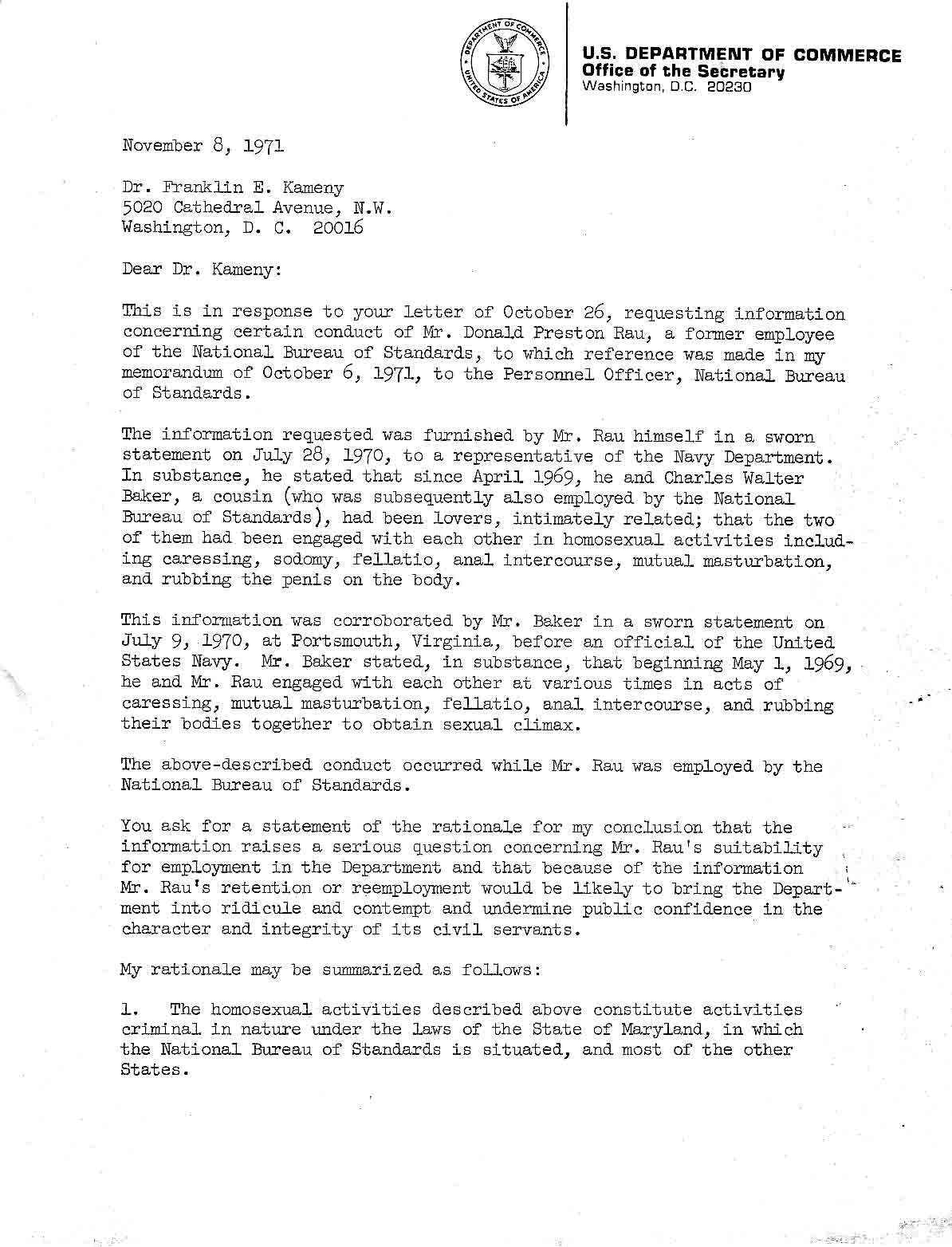
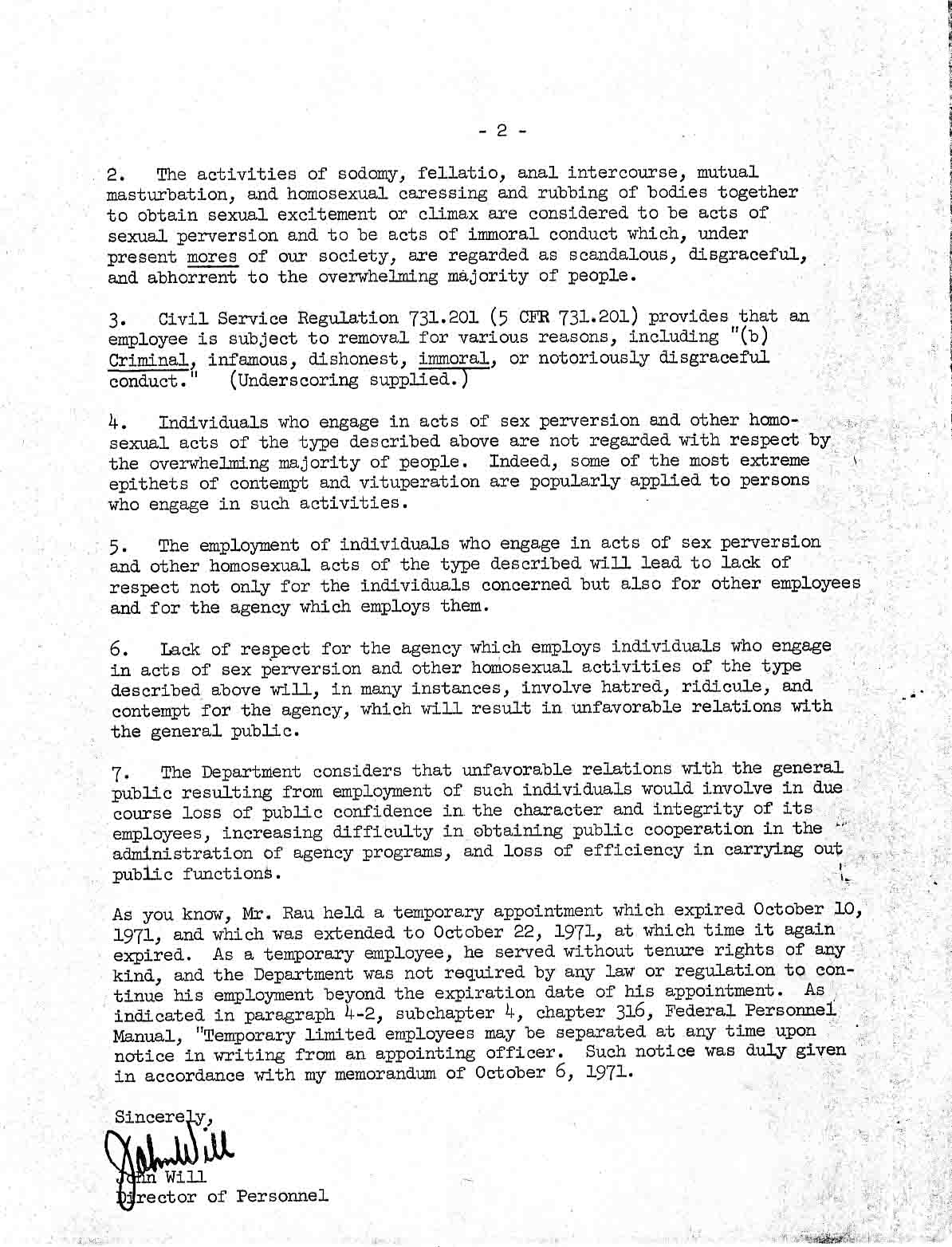
...in November of 1971, the federal personnel office wrote this letter to Frank Kameny, the pioneering gay-rights activist (still going strong, btw), in response to Kameny's protest of the firing of a gay federal employee named Donald Preston Rau:

The activities of sodomy, fellatio, anal intercourse, mutual masturbation, and homosexual caressing and rubbing of bodies together to obtain sexual excitement or climax are considered to be acts of sexual perversions and to be acts of immoral conduct, which, under present mores of our society, are regarded as scandalous, disgraceful, and abhorrent to the overwhelming majority of people. ...

Individuals who engage in acts of sex perversion and other homosexual acts...are not regarded with respect by the overwhelming majority of people. Indeed, some of the most extreme epithets of contempt and vituperation are popularly applied to persons who engage in such activities...

The letter goes on, and on, in that vein (the first page is here).

And today? On April 3, 2009 (the same day, as it happens, when Iowa's Supreme Court ruled for gay marriage), John Berry, an openly gay man, was confirmed to head that same federal personnel office. And the 1971 letter to Kameny is, literally, a museum piece: it's in the Library of Congress, along with the rest of Kameny's papers. No comment I could make could say more than that.

(Hat tip to Charles Francis of the Kameny Papers project.)

It gets better: Via email, Frank Kameny explains that this case was part of litigation which, in 1973, produced a court order that led to the lifting of the federal gay-employment ban in 1975. He says he was told by a government official, "'The government has decided to change its policies to suit you,' which I have always cherished."

Frank continues:

In the 1960s [John W.] Macy's CSC [the Civil Service Commision, antecedent of today's Office of Personnel Management] would not even meet with us, to discuss these issues, until we picketed them on June 25, 1965. But they remained adamant, as the Library of Congress letters show.

I had thought that the issue of gays in government was long nicely settled and behind us. But now - to have an openly gay man appointed as the successor, several steps removed, to Macy and Hampton [Macy's successor]!!! They must be turning over in their graves. And I feel truly vindicated beyond anything I might ever have expected or imagined. It's like the perfect, contrived happy ending to a fictional fairy tale. It's too perfect to be true in reality. But there it is.

No, wait, it gets even better:

Berry has personally invited me to be present at his swearing-in.

Words fail, except to say: Thank you, Frank.

Dreher’s Conversation With No One

Rod Dreher has two new posts about same-sex marriage here and here.

The first purports to answer the arguments of Damon Linker and Andrew Sullivan, but does not. In response to Linker's arguments, Dreher dismisses Linker's casual summation of their disagreements, and then goes into a lengthy critique of liberalism's hegemony in modern America. He then observes it's hard for conservative arguments against same-sex marriage to be taken seriously, and moves on. He does not mention, much less answer any of Linker's substantive arguments. With Sullivan, too, Dreher finds a snippet about the Pope objectionable, and defends orthodox religious thinking about moral authority. But again, he does not engage any of Andrew's arguments in favor of same-sex marriage and show why they are wrong. Instead, he repeats the trope that if we have same-sex marriage we're getting polygamy, too, and bemoans the fact that we keep talking past each other and getting all emotional.

His second post asks whether gay marriage will strengthen same-sex unions or undermine the concept of marriage - a binary formulation that leaves unexamined the possibility that it might strengthen same-sex unions and strengthen marriage as well; or leave marriage unchanged in the minds and relationships of most heterosexuals. He then returns to form (at least on this issue) by finding quotes from liberal stalwars like Matt Foreman, Joe Solomonese and Jenny Pizer, and linking to the bête noir of the right, the "manifesto" called "Beyond Same-Sex Marriage," which was recently cited by the American Law Institute. Again, Dreher doesn't man up to the best arguments being made in favor of same-sex marriage, focusing on liberal boogeymen who are much easier to refute. "Beyond Same-Sex Marriage" may not be the Protocols of the Elders of The Castro, but it's not anything that's ever driven the debate over same-sex marriage, and is far more popular as a whipping boy of the right than as an agenda for much of anyone.

I think this shows that, while several of us are very interested in engaging him in the debate, it is Dreher who is talking past us - or, more accurately, around us. There was plenty to respond to in both Linker's and Andrew's posts for anyone who wanted to engage the issue of same-sex marriage in a pluralistic democracy - which is the question. I, too, had a couple of what I think of as serious issues with Dreher's arguments that might be worth responding to.

Those were not the arguments Dreher chose to take on. If you want to have a discussion with someone, it's hardly polite to keep referring to someone else's arguments, and ignoring what the people you're supposed to be conversing with are saying.

Pay for Performance?

The Washington Blade's annual look at compensation paid to, as they term it, "leaders of the LGBT rights movement," is always an interesting read. But the real issue isn't just the level of pay; I agree that, in general, CEOs of nonprofits should earn what the competitive market deems is fair. The broader, and far more important question, is the same one that's being asked of private-sector CEOs these days - does the level of their individual performance this past year still entitle them to receive what would otherwise by deemed fair compensation for their positions? Or should there by some "clawback" (i.e., recouping promised compensation in light of poor performance) for these executives as well?

Given the devastatingly bad leadership shown on the part of some, particularly as regards the debacle of California's Proposition 8, a campaign mismanaged to an extraordinary degree, should Lorri Jean of the LA Center still be getting $327,000? (The Advocate, in its "Anatomy of a Failed Campaign," called her one of "the small clique of California LGBT leaders" who were in charge of directing, or misdirecting, opposition to the initative.) Should Joe Solmonese, under whose management the bulk of HRC's efforts went to getting out the vote for Obama instead of fighting the three statewide anti-gay marriage initiatives that were passed, be receiving $338,400? Or would it be more just to direct their way some of the same outrage over the bonuses being paid to executives who ran their companies into the ground?

Straight Debate

An excellent and enlightening discussion has broken out over gay marriage between Rod Dreher at Beliefnet and Damon Linker at TNR. (In order, the posts are here, here, here, here, and here) Andrew Sullivan weighs in at length, and does a lot of the heavy lifting to add a gay perspective to the discussion. There are only three additional points I want to add.

First, and most obviously (and therefore most in need of being pointed out) this is a debate between two heterosexual men about gay equality. That, by itself, is important. Women have historically been more comfortable discussing homosexuality than straight men, but that seems to be changing for the better. Some of the debate focuses on Linker's characterization of Dreher as having a "fixation" on homosexuality. This is unfortunate because it is a distraction about a personal and subjective matter. I am happy to set aside that issue and accept that Dreher simply wants to engage the debate, and good for him. However, it is certainly worth noting, as Dreher does on his two primary posts, that (whatever his own feelings) his comments section heats up whenever he mentions "anything related to homosexuality." Why does Dreher need to warn his commenters (in bold): "Please watch how you discuss and debate this topic in the comboxes." That's not Dreher's "fixation,' but it's certainly not unusual, and if it doesn't make Linker's point, it makes some point worth thinking about.

Second, Dreher makes a not uncommon argument that gay supporters are being unfair to opponents:

"By casting the ordinary defense of normative Christian doctrine about homosexual relations as though it were a sort of mental illness, the pro-SSM side engages the issue not in a fair-minded discussion and debate about legitimate issues related to gay marriage and the normalization of homosexuality in our society, but as an ideological war to be won by any means necessary. Any critique of the pro-SSM side is to be treated as a sign of pathology."

This language should ring a bell for those of us who are gay, something heterosexuals might miss. In fact, for many decades, homosexuality was not just a rhetorical "sort of mental illness" or a mere "sign of pathology," it was mental illness and pathology itself. Lesbians and gay men were put in actual mental institutions, were subjected to forced "cures" for their disease. When those who argue against gay equality are subject to that kind of action, Dreher's complaint will ring a little less ironically - and a little less hollow.

Finally, Dreher makes the point that:

"This stuff matters. It matters a lot. If you are a gay person, you know how much it matters to you. Why should anybody be surprised that it matters to traditional Christians, and for reasons that go far beyond any supposed anti-gay animus?"

There is, of course, a difference between how this matters to gay people and how it matters to traditional Christians. It matters to gay people because the secular law treats us differently - provides us both fewer rights and in many cases, none at all for our relationships - than heterosexuals take for granted. It matters to traditional Christians, not because they are denied anything, but because civil equality is a different rule than their sacred texts seem to support. There is, of course, dispute even among Christians about that, which is why Dreher has to qualify "Christian." But even if this view of scripture were universal, or (as in the Catholic hierarchy), authoritatively defined by a single leader, Americans live in a pluralistic nation of motley religious and irreligious views. Traditional Christians have every right to make whatever case they believe, but have to know that arguments from religious authority will only go so far in a debate about the civil law.

It is the collapse of the secular arguments against gay equality, one by one, that has left religious arguments standing alone. The fact that "traditional" Christians have to identify themselves now reveals they are appealing, not to "religion," but to a particular approach to religion that is, itself, part of America's religious pluralism. After all, Dreher first weighed in on this issue in response to a post at Andrew Sullivan's site about how a gay man's reference to his husband at their Catholic parish was accepted as unremarkable.

Come out, come out. . . except the homosexuals — you guys stay in

The U.S. Census is gearing up a monumental effort to make sure minorities are counted in 2010.

But that effort will not apply to homosexuals. As I argued in The Pretenders, the Census folks, far from seeking us out, are doing all they can to make sure we are not counted -- at least not our married couples.

And that is a very clear public policy choice. The government wants, very much, to know how many racial and ethnic minority members we have, so it can make sure their concerns are being addressed. But the government does not want to know how many same-sex couples there are, which frustrates the ability to have our concerns addressed.

The Census is a very good way of discerning what the government wants to know, and what the government wants to keep hidden. And it is up to us to keep asking why they have an interest in keeping the number of our publicly acknowledged relationships invisible.