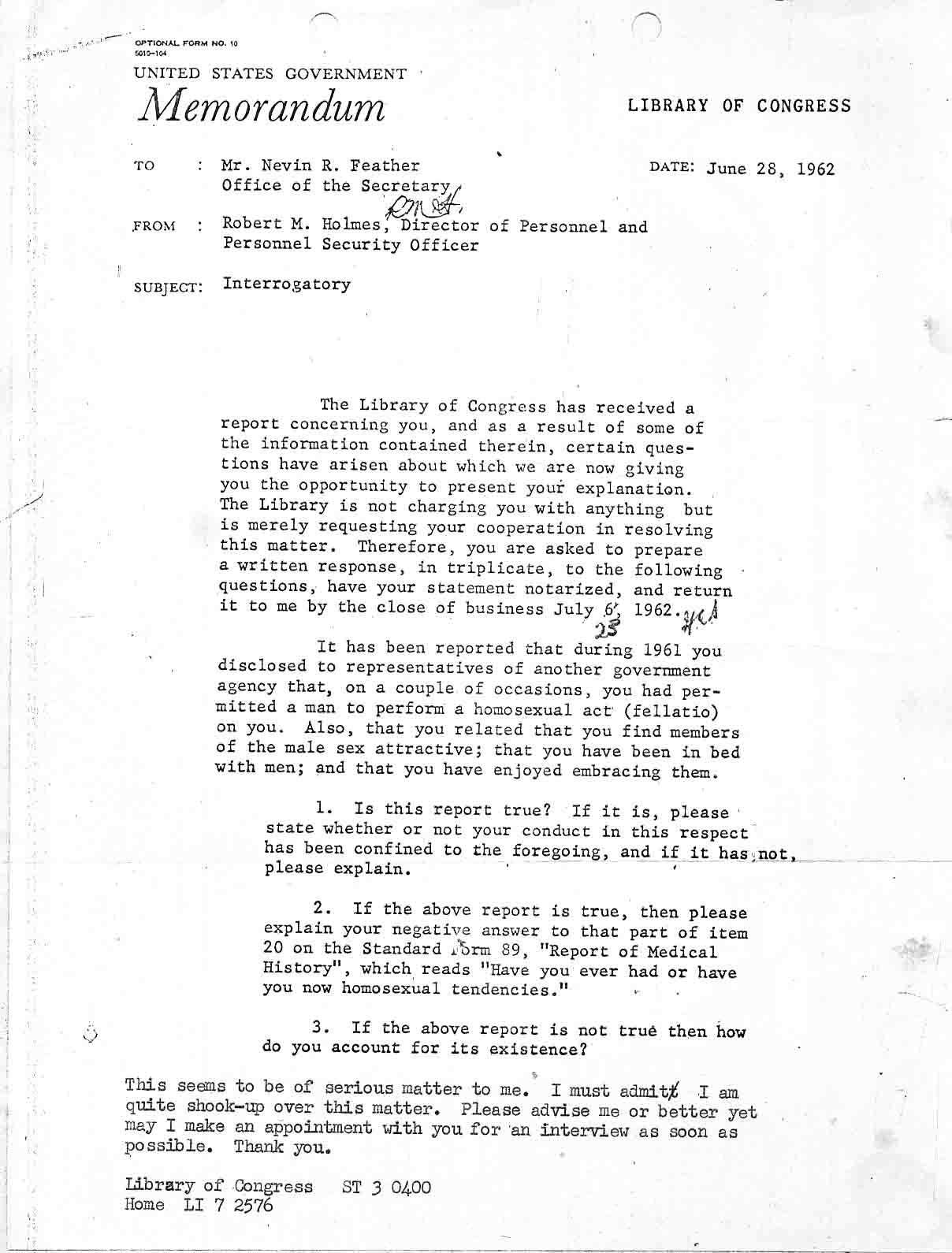
It's official. Frank Kameny has entered history--literally. Forty years ago, this civil-rights pioneer came to the aid of a frightened Library of Congress employee who was accused of "enjoying" the embrace of men. (I am not making that up.) On Oct. 6, that same Library of Congress accepted Kameny's papers and cemented his place in history's pages. Professional archivists will now painstakingly sort thousands of documents--the gift of Charles Francis's Kameny Project, which raised $75,000 to purchase and donate them--and will ensure their availability to generations of students of U.S. civil rights. There is no better record of the torment that homosexuals endured at the hands of their government in the 1950s and 1960s. And there could have been no finer tribute to Kameny than the ceremony at the Library. If there were any dry eyes in the house after Frank accepted the tributes and took his seat, mine weren't among them.
ADVERTISEMENT
The Witch Hunt on the Hill.
The National Gay and Lesbian Task Force has rightfully condemned "emerging attempts to shift responsibility for the Foley scandal by blaming gay Republican congressional staffers for supposedly covering up prior reports of predatory behavior by former Rep. Mark Foley." A release from the group further states:
Discussions of a supposed network of closeted gay Republicans working on Capitol Hill have swept the blogs and been raised on MSNBC and CBS. There are allegations, for example, that gay former Foley aide Kirk Fordham, the recently resigned chief of staff for Tom Reynolds (R-NY), worked to play down complaints about Foley's behavior. Fordham has said that more than three years ago he had "more than one conversation with senior staff at the highest level of the House of Representatives asking them to intervene. ...
The parallels to McCarthyism are chilling. Here it is gays, not communists, "operating at the highest levels of government." ...
While many Democrats may be taking real pleasure in watching the GOP twist and turn, it's long past time for them-and other leaders-to denounce these shameful, gay-baiting, responsibility-evading tactics.
I'd go much further: Both Democrats and social conservatives have quite openly been fanning the flames of homophobic panic in an attempt to secure political advantage.
More.
Gay Patriot cites a blog posting by David Corn, a columnist for The Nation, here, describing how some gay Democrats have been sending to social conservatives copies of "The List" of gay staffers working for Republicans on the Hill, in an effort to get them fired.
The WSJ's Daniel Henninger looks at the political/media circus, noting, "I have an idea: Let's fire the Members and replace them with the pages. We could do worse. We are."
National Journal calls the Foley scandal "A Calamity for Gay Republicans."
From the Drudge Report:
According to two people close to former congressional page Jordan Edmund, the now famous lurid AOL Instant Message exchanges that led to the resignation of Mark Foley were part of an online prank that by mistake got into the hands of enemy political operatives, the DRUDGE REPORT can reveal.
According to one Oklahoma source who knows the former page very well, Edmund, a conservative Republican, said he goaded an unwitting Foley to type embarrassing comments that were then shared with a small group of young Hill politicos. The prank went awry when the saved IM sessions got into the hands of political operatives favorable to Democrats.
32 Comments
Foley’s Folly: The GOP’s Gay Problem
The tragic opera of former congressman Mark Foley is the revenge of don't ask, don't tell.
Foley, a Republican from Florida, resigned Friday after e-mails and instant messages between him and several teenage congressional pages surfaced. The Republican leadership knew that at least one page had gotten e-mails where Foley admired the body of one of the page's friends, and asked the page for a picture of himself, e-mails the page naturally found sick and a bit creepy.
Republican leaders responded to the potential political problem by telling Foley to knock it off. With respect to the larger issue, though, there was no asking or telling. The boy's own revulsion at the obviously inappropriate attention was ignored, not only by Foley's partisan fellows, but by some news outlets that also had seen the e-mails.
If this has a familiar ring, look in the Catholic Church for the bell. Republican leadership was acting like the Catholic hierarchy, which played shell games with men accused of sexually abusing children. And there's a good reason for the similarity. The inability to deal straightforwardly with gay people leads to other kinds of truth-avoidance when things go south. But that's what comes from not wanting to know something, and going out of your way to remain ignorant.
We've come a long way since homosexuals had two basic options: the closet or jail. But a good portion of the electorate, most of them Republican, still seems to long for the good old days when we didn't have to think about ``those people." Both Libertarians and, generally, the Democratic Party have withdrawn their official support for the closet over time. States, too, are seeing what a losing battle this is, and allowing homosexuals to live their lives in conformity with, rather than opposition to, the law.
But that leaves Republicans and the religious right trying to live a 1950s lie in the new millennium. As Foley prepared in 2003 to run for the Senate, newspapers in Florida and elsewhere published stories about his homosexuality. But you'd never hear any of his colleagues saying such a thing. And Foley himself refused to discuss the issue, until his lawyer acknowledged Wednesday that the former congressman is indeed gay.
Being in the closet is hard to pull off without help, and for years Foley was eagerly abetted by his Republican brethren, whose willful blindness is at the heart of the current tragedy. Speaker J. Dennis Hastert, majority leader John Boehner, and others in the House leadership are still under the impression that the closet, like Tinkerbell, will continue to live as long as we all believe. And believe, they do -- against all the evidence.
But the number of people who believe in the closet is declining day by day and generation by generation. Hastert and the rest of his cronies are their own victims. The political turmoil they caused for themselves is only just.
But their failure to acknowledge the obvious reality has other victims as well: the boys whom Foley apparently pursued. Some of the messages show some tolerance of Foley's advances, but not much more. This was no one's ``Summer of '42." The healthy disgust in one boy's use of the word ``sick" repeated 13 times seems about right.
But what can one expect from denying grown men -- and women -- a normal, adult sex life? Whether the denial of adult intimacy comes from religious conviction or the ordinary urge toward conformity, people who run away from their sexuality nearly always have to answer to nature somehow. For people who fear abiding and mutual love, the trust and confusion of the young is a godsend. Add to that the perquisites of power, and a degenerate is born.
Fortunately for the arc of justice, the closet ultimately works against itself. Foley's case and the Catholic Church's sex abuse scandal are the last screams of the dinosaurs. It took the dinosaurs a long time to finally die off, or evolve into creatures that could continue to survive, and the same will be true of the closet's final supporters. But they will look more and more ridiculous each time that they take pride in holding up the ruins of this particular antiquity while tending to the wounded when the building again collapses.
Like the Catholic Church, the Republican Party in Washington guarantees its own future calamities in its enduring and steadfast habit of pretending that, unlike heterosexuality, homosexuality can be either denied or suppressed.
17 Comments
Foley’s Folly: A Lesson
It is early yet to talk about "the moral of the story" with respect to Mark Foley. Foley, a Republican congressman from Florida, resigned last week after it was revealed that he had been sending sexually explicit e-mails and instant messages to underage congressional pages. Here's a sample (the spelling is left uncorrected):
Foley: what you wearing
Teen: normal clothes
Teen: tshirt and shorts
Foley: um so a big buldge….
Foley: love to slip them off of you
Teen: haha
Foley: and [grab] the one eyed snake….
Teen: not tonight...dont get to excited
Foley: well your hard
Teen: that is true
Foley: and a little horny
Teen: and also tru
Foley: get a ruler and measure it for me
The FBI is investigating, and criminal charges appear likely. Though initial reports involved relatively tame e-mails to a sixteen-year-old former page, the IM's (such as the one cited above) appear to involve a different youth about whom little has been reported. The age-of-consent is 16 in D.C., but it's 18 in Florida, unless the accused is under 24 (Foley is 52).
Foley was long rumored to be gay. Nonetheless, he was a popular Republican congressman who prior to the scandal was considered a shoo-in for re-election. He was also the co-chairman of the House Caucus on Missing and Exploited Children, an outspoken foe of sexual predators on the Internet, and a vocal supporter of President Clinton's impeachment.
Hypocrite? Almost certainly. Child molester? Probably not. Sixteen- and seventeen-year-olds are not quite children (they're not quite adults, either), and there is no evidence yet that Foley actually made or attempted to make physical contact with the objects of his Internet dalliance. Still, as the congressman surely knew, Florida law makes it a third-degree felony to transmit "material harmful to minors by electronic device" and defines such material to include descriptions of "nudity, sexual conduct, or sexual excitement."
There's also the issue of sexual harassment and abuse of power. Even former pages have strong incentive to stay in the good graces of the congressmen who employed them. While the youth in the above exchange does not seem (judging from the text) to be terribly troubled by the banter, at least one other complained that Foley's advances were "sick sick sick sick sick…"
Without a doubt, Foley did some stupid, inappropriate, and unethical things. Granted, sexual desire causes many of us to do stupid (though not necessarily inappropriate or unethical) things from time to time. Granted, the case would garner a somewhat (though not completely) different reaction if Foley were female--and particularly, if he were an attractive female. If Foley looked like Demi Moore, the pages would be telling one another "Dude, yeah!!!" instead of "sick sick sick sick sick."
But the "gay angle" on this contains an important lesson, one that is unfortunately likely to be either distorted or missed entirely amidst the partisan political drama. It is that gay people, like everyone else, need healthy outlets for sexual expression. When those are blocked--because of political ambition or a repressive church or a right wing bent on ignoring basic science--cases like Foley's (or former Spokane mayor Jim West's or former New Jersey Governor Jim McGreevey's) become more likely, as do far greater tragedies like the Catholic Church's sex-abuse scandal.
This is not to deny that Foley is responsible for his actions. There is no contradiction in holding a person fully responsible for wrongdoing and holding others responsible for enhancing the conditions that make such wrongdoing likely.
The right wing is doing just that by refusing to face some simple facts: There are gay people in the world. Gay people need love and affection like everyone else. When people repress that need in themselves or others, it tends to assert itself in unfortunate and sometimes tragic ways.
Like most people, I want to shake Mark Foley and yell: What the hell were you thinking? But I also want to add the following: It didn't have to be this way. There are young men of legal age who are not your subordinates who would have been happy to remove their shorts for you. And there would have been nothing wrong with that per se. An open, honest, consensual sex life is not only possible for gay men; it's healthy. The alternatives can be disastrous.
Yes, it is early to talk about the moral of the story. But there are lessons to be learned, and we ignore them at our peril.
17 Comments
ADVERTISEMENT
Internalized Homophobia — Not
Not long ago I was cleaning out some old files and ran across one labeled "Homophobia--Internalized." Into it I had stuffed articles that purported to analyze why gay men engaged in such risky harmful activities as heavy drinking, crystal meth use, and unprotected receptive anal sex.
After a good deal of tut-tutting about the irrationality of putting oneself at risk for physical and mental deterioration and sometimes death, the articles often suggested that the explanation was "internalized homophobia" a supposed hatred of oneself as homosexual.
"Self-hating homosexual" was also used by gay leftists to describe gays who support conservative politicians and could equally have been used by moderate gays to refer to far-left gays whose main goal was to push gays into working for "the worldwide socialist revolution" (remember that?). Both, of course could have retorted that they supported gay equality but there were other political goals they valued more.
But "internalized homophobia" is a little too pat, too readily invoked, too all-encompassing. What disadvantageous or harmful behavior could it not purport to explain? I have to say, too, I don't think I have ever met a real instance of internalized homophobia. I think it is a label that doesn't refer to anything real--like "the ether" or "phlogiston."
I know of gay men who wished they were not gay. They say being heterosexual would make their life easier. They wish they could marry and sire children, or please their parents, or please their god. But none of them hate his whole self. Sadly, a few gay men do kill themselves, but they seldom if ever engage in typical "risk behaviors" as a way to do it gradually. They do it and get it over with.
It seems to me that people engage in so-called "risk-behaviors" for a simple reason: They are enjoyable; they feel good now. It is only in the long run that most risky behavior turns out to be harmful. And the further off the future, the more the consequences are discounted in our calculations about whether to do something enjoyable in the here and now.
Consider too that some heterosexual men also regularly engage in risk behavior. They use crystal meth and heroin, they drink heavily, they have sex with girl friends without a condom (risking unwanted paternity or the costs of an abortion). They parachute jump, race automobiles on city streets, get into fights. All these entail risk but the potential costs are uncertain or somewhere off in the future--and the pleasures are in the present, some of them very intense pleasures. No one diagnoses them with "internalized heterophobia" or calls them "self-hating heterosexuals." Instead, people look for other reasons for their behavior: they are fun, they are exciting, they provide an adrenaline rush, they are totally absorbing.
Show me an instance in which gay men engage in behavior with potentially harmful consequences but no benefit in terms of present pleasure or cessation of physical or emotional pain, an instance that cannot be found among heterosexual men, then I will reconsider "internalized homophobia."
At this point we could wonder whether explaining gay men's behavior with an easy and dismissive "internalized homophobia," without carefully examining the specific reasons or motivations of individual men involved is itself a kind of de facto homophobia. No doubt many of these people in the so-called "helping professions" would deny that emphatically. But failing to treat gay men the same way they would treat similarly situated heterosexual men amounts to heterosexism at least.
But instead of just condemning writers who fall back too easily on "internalized homophobia," it would be helpful to have a more satisfactory alternative explanatory model. "Time preference"--the relative weight anyone gives to present costs or benefits (pleasures) versus longer term costs or benefits--provides a clearer explanation. But time preference is part of the tool kit of economists while homophobia is in the tool kit of sociologists and psychologists and the disciplines seldom talk to each other.
The issue of "time preference" is particularly important in assessing gay men's behavior. Most heterosexual men marry and eventually produce dependent children. Because they now have other people who depend on them they have a greater incentive to think about the longer term. Not coincidentally, it is young single males who most engage in high risk behavior.
Since gays are denied marriage or civil unions, society fails to provide them with this incentive to develop a similar long-term perspective. In significant ways, most gay men remain single males all their lives. And because they do not have access to the ceremonies and other markers that bolster an internalized sense of socially certified adulthood (marriage, the birth of children), they remain in some sense young. This may have good effects as in preserving the free play of youthful creativity, but it also fails to promote that lengthening of a person's time preference which would discourage these much discussed risk-behaviors.
5 Comments
As November Approaches…
It's all politics, of course, in the era of the October Surprise (an "unkown source" first gave the Foley e-mails to ABC News). And here's how the game is played out (from a campaign press release):
Richard Wright, Democratic Party nominee for the House of Representatives in the 4th Congressional District [in Washington state], will hold a press conference Tuesday morning in Pasco to demand that Congressman Doc Hastings explain why he is not investigating House leaders who were aware of the sexual predatory activities of a Florida Congressman but did nothing about it for months.
The Democrats: Our best hope against the forces of perversion!
More. Gay Democratic activist Mike Rogers brags about his role.
As one of our commenters, "Guy," suggests, the scandal is causing a huge anti-gay political backlash that's likely to ensure passage of all the anti-gay amendments. I've also heard that it's leading to a purge of gay/gay-friendly GOP staffers on the Hill, now seen as "pedophile protectors."
Also. If the House leaders had moved earlier to censure Foley, as high-horse Democrats declare they should have, based on the evidence they had at the time - overly solicitous e-mails to male pages (and not the IMs) - can you imagine the cries of "homophobia" for Democrat/gay activists!
37 Comments
Congratz to Jamie Kirchick
IGF's James Kirchick is winner of the 2006 National Lesbian and
Gay Journalists Association's Excellence in Student
Journalism award. You'll find a selection of his writings
here. They'd
be impressive even if he hadn't still been an undergraduate when
most of them were written. We'll be hearing more from
Jamie.
1 Comment
ADVERTISEMENT
Foley and Clinton.
I received the following provocative query on the Foley scandal and thought some readers might find it worth discussing:
The Democrats are totally on the warpath about Foley and the GOP leadership-what did they know and when did they know it? It's outrageous not to have kicked him out way back when! And the media are reacting the same way.
But the Democrats (except Lieberman) never wavered in their insistence that Clinton's actual sexual contact with a young intern was completely irrelevant, and the media largely agreed, after they got the thrill of reporting the salacious story.
So-is it just partisanship? or homophobia? or truly the distinction between a 16-year-old former page and a 22-year-old intern that makes the difference in the reaction?
It's fair to say that Monica was an adult and the page wasn't. But I can't believe that people who are SO outraged over this would be totally indifferent to a 55-year-old married man bagging a 22-year-old who worked for him.
I think homophobia plays some part in this (the anti-gay Family Research Council makes that explicit), and much of the expressions of outrage convey that there is no possibility, ever, that a 16-year-old guy could be sexually interested in an older man.
That's not to say this was appropriate behavior by a congressman toward a page (it was not) or to deny it was outright sexual harassment (though that case hasn't been proved). It's just to recognize that gay-predator tropes are in full flower.
And the Democrats are fanning the flames, hoping to alienate the GOP base and keep 'em home on Nov. 7. My, what a surprise that this all hit the presses just weeks before the election!
It's often said of popular representatives (like Foley was) that the only way to bring them down is to catch them with a dead girl or a live boy. How true that's turned out to be.
More still. A video re-enactment.
72 Comments
The Wages of Homophobia?
I had missed this watching news coverage of the Wisconsin high school student who shot his principal dead:
[Eric] Hainstock said that a group of kids had teased him by calling him "fag" and "faggot" and rubbing up against him, the complaint said, and the teen felt teachers and the principal wouldn't do anything about it.
So Hainstock decided to confront students, teachers and the principal with the guns to make them listen to him, according to the complaint.
So Friday morning, he pried open his family's gun cabinet, took out a shotgun and then took a handgun from his parent's bedroom, the complaint said.
If true, it of course dosen't excuse murder. But the blind eye that educrats give rank homophobia in their schools is also inexcusable.
15 Comments
What’s in a Name?
In California, Gov. Arnold Schwarzenegger signed a bill that allows registered domestic partners to file joint tax returns and have their earned income treated as community property for state tax purposes. There is now virtually no distinction between the rights of married couples and those of domestic partners under state law.
DPs, however, are denied the federal spousal benefits, and must file separate federal tax returns. The same also is true of same-sex couples legally married in Massachusetts, thanks to the federal Defense of Marriage Act.
Last year, Schwarenegger vetoed a bill that would have provided for same-sex marriage outright in the Golden State, citing the defeat of same-sex marriage when the electorate voted on this issue. But if the domestic-partner route becomes virtually the same as marriage (at least at the state level), then the cultural shift that deflates popular opposition to the "m" word is well underway.